


HOW BARTER COLLABORATIONS HELP BUSINESSES GROW IN 2026
Marketing has changed.
Earlier, businesses mainly depended on advertisements, banners, newspapers, television, and word-of-mouth referrals to reach customers.
Today, customers discover brands through Instagram Reels, YouTube videos, creator recommendations, reviews, UGC, and social media communities.
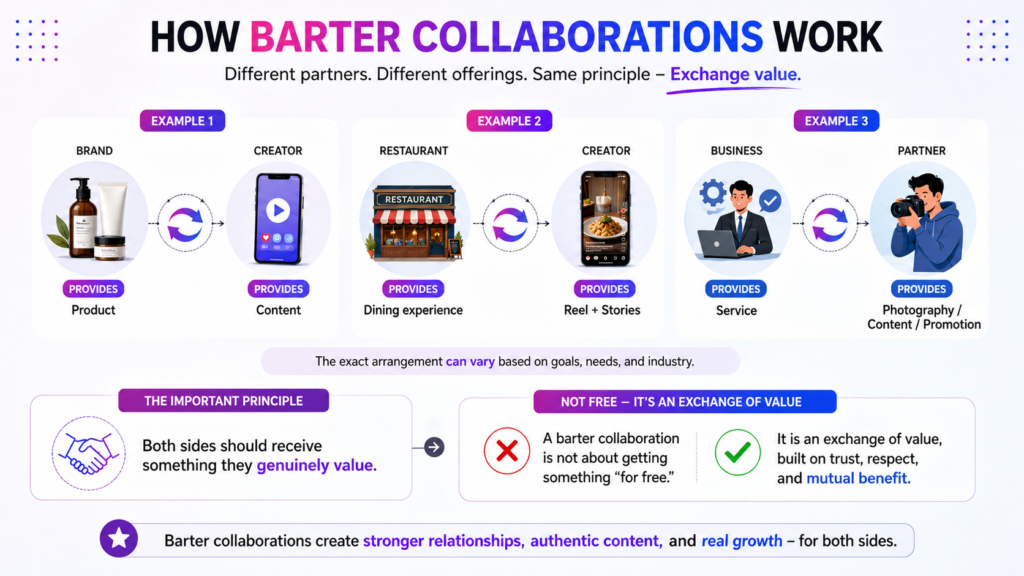
This change has created a new opportunity for businesses: barter collaborations, A business can provide its product, service, experience, or another form of value to a creator or partner, while receiving content, exposure, or another agreed benefit in return.
It sounds simple, but when planned properly, a barter collaboration can become more than a product exchange.
It can help a business build visibility, social proof, content, relationships, and new customer touchpoints.
So, why are businesses paying more attention to barter collaborations?
Let’s understand.
WHAT IS A BARTER COLLABORATION?
A barter collaboration is a partnership where two parties exchange products, services, experiences, content, expertise, or promotional value instead of relying entirely on a traditional monetary payment.
WHY ARE BARTER COLLABORATIONS IMPORTANT FOR BUSINESSES TODAY?
The biggest reason is simple:
People don’t only want advertisements. They want experiences, opinions, demonstrations, and recommendations.
Creators can show products in real-life situations, explain how they work, and introduce brands to communities that already follow their content.
This creates more opportunities for businesses to connect with relevant audiences through authentic-looking content and creator recommendations.
This doesn’t mean every business should immediately start sending products to hundreds of creators.
It means businesses now have more ways to distribute their products and stories.
Barter collaboration can be one of those ways.
HOW BARTER COLLABORATIONS HELP BUSINESSES GROW
1. BARTER COLLABORATIONS CAN INCREASE BRAND AWARENESS
One of the first benefits is visibility.
Suppose a local skincare brand has 2,000 followers.
Instead of only posting on its own Instagram account, it collaborates with several relevant creators.
The creators introduce the product to their own audiences.
Now the brand has multiple opportunities to be discovered.
The important point is not simply the number of followers.
Relevance matters more than vanity metrics.
A creator with 8,000 highly relevant followers may be more useful to a niche business than a celebrity with millions of followers but little connection to the product category.
2. BARTER COLLABORATIONS CAN GENERATE USER-GENERATED CONTENT
Content is one of the biggest challenges for modern businesses.
Brands constantly need:
• Reels
• Product photos
• Stories
• Testimonials
• Demonstrations
• Unboxing videos
• Reviews
• Lifestyle content
A well-planned barter collaboration can help generate some of this content.
For example: Brand provides: Product
Creator creates:
• 1 Reel
• 2 Stories
• Product photographs
The brand can potentially use approved content across its social channels, website, or other marketing touchpoints, subject to the agreed usage rights.
This makes barter collaboration particularly useful for businesses that need a steady flow of authentic-looking content.
3. BARTER COLLABORATIONS CAN HELP BUILD SOCIAL PROOF
Imagine two brands selling similar products.
One brand’s Instagram page has only product posters.
The other has:
• Customers using the product
• Creator reviews
• Reels
• Testimonials
• Unboxing videos
• Real experiences
Which one feels more trustworthy?
For many customers, seeing a real person interact with a product can reduce uncertainty.
That is why social proof matters.
A barter collaboration can help a growing business collect real-world experiences and content that demonstrate how its product or service fits into people’s lives.
4. BARTER COLLABORATIONS CAN HELP SMALL BUSINESSES TEST INFLUENCER MARKETING
Not every business has a large marketing budget.
For startups, local businesses, D2C brands, restaurants, salons, fashion labels, and other growing companies, investing heavily in every marketing channel can be difficult.
Barter can provide a way to test creator marketing before committing a larger cash budget.
For example:
TEST
Work with 10 relevant small creators.
MEASURE
Track:
• Views
• Engagement
• Profile visits
• Website traffic
• Enquiries
• Coupon-code usage
• Leads
• Sales
LEARN
Identify which creators, content formats, and audiences perform best.
SCALE
Invest more in the partnerships that demonstrate meaningful results.
This makes barter collaboration a potential testing mechanism, rather than just a cost-saving tactic.
5. BARTER COLLABORATIONS CAN HELP BUSINESSES REACH NICHE AUDIENCES
Large audiences aren’t always the goal.
Sometimes, the right small audience is much more valuable.
For example: A local fitness studio may benefit more from collaborating with fitness creators in its city than with a national lifestyle celebrity.
A regional food brand may benefit from local food creators.
A beauty brand may benefit from creators whose audience is genuinely interested in skincare or makeup.
The right audience can create more meaningful opportunities for awareness, engagement, enquiries, and sales.
6. BARTER COLLABORATIONS CAN CREATE LONG-TERM CREATOR RELATIONSHIPS
The first collaboration doesn’t have to be the last.
Imagine a creator genuinely likes a brand’s product.
The first collaboration is barter. The creator performs well. The brand continues working with the creator.
Eventually, the relationship can develop into:
Barter → Affiliate → Paid Collaboration → Brand Ambassador
Not every partnership will follow this path, but the possibility of developing long-term relationships is one reason businesses should evaluate creators based on quality and fit, not just one post’s reach.
7. BARTER COLLABORATIONS CAN REDUCE UPFRONT MARKETING COSTS
This is probably the most obvious advantage.
Instead of paying every creator a separate fee, a business may exchange its product or service for agreed promotional value.
For a product-based company, the cost of producing one additional unit may be significantly lower than paying a creator’s full commercial fee.
However, this does not mean barter marketing is free.
The business still needs to consider:
• Product cost
• Packaging
• Shipping
• Team time
• Creator management
• Content review
• Tracking
• Opportunity cost
A good barter strategy is about efficient value exchange, not pretending marketing has no cost.
8. BARTER COLLABORATIONS CAN HELP BUSINESSES DISCOVER NEW CREATORS
Another benefit is experimentation.
A business doesn’t have to work only with creators it already knows.
It can test different:
• Niches
• Locations
• Content styles
• Audience sizes
• Languages
• Platforms
For example, a Delhi-based fashion brand could test:
Fashion creators + college creators + lifestyle creators + local creators
After measuring results, the brand can identify which segment produces the strongest response.
This creates useful marketing data.
Step 1
DEFINE THE OBJECTIVE
First decide what you want.
Is the goal:
• Brand awareness?
• Product discovery?
• UGC?
• Website traffic?
• Leads?
• Sales?
• Social proof?
Without a clear objective, it becomes difficult to judge success.
Step 2
IDENTIFY THE RIGHT CREATORS
Don’t select creators only because they have large follower counts.
Check:
Audience: Is their audience relevant?
Content: Is their content suitable for your brand?
Engagement: Do people actually interact with their posts?
Location: Is the creator relevant to your target geography?
Brand Fit: Would their personality naturally fit your product?
Step 3
CREATE A CLEAR BARTER OFFER
Don’t send a vague message like:
“Hey, want to collaborate?”
Explain what you’re offering and what you’re expecting.
For example:
We provide: Product worth ₹X
You provide: 1 Reel + 2 Stories
Timeline: Within X days
Content requirements: Product mention, tag, CTA
The exact deliverables should always be mutually agreed.
Step 4
AGREE ON DELIVERABLES
Before sending the product, confirm:
• Number of posts
• Number of stories
• Content format
• Timeline
• Tags
• Mentions
• Hashtags where relevant
• Approval process
• Usage rights
• Disclosure requirements
This prevents confusion later.
Step 5
TRACK THE RESULTS
Don’t stop after the content goes live.
Track: Reach → Engagement → Profile Visits → Website Visits → Leads → Sales
Depending on the campaign, you can also use:
• UTM links
• Unique discount codes
• Affiliate links
• Landing pages
• Lead forms
This turns barter collaboration from a guessing game into a measurable marketing activity.
HOW BUSINESSES CAN GROW THROUGH BARTER COLLABORATIONS
Growth doesn’t happen simply because a creator posts about a product.
The real growth happens when the business connects collaboration with a broader marketing funnel.
Here’s a simple example:
- 1
Awareness
Creator posts a Reel. - 2
Interest
Audience visits the brand profile. - 3
Consideration
They watch more content and read reviews. - 4
Action
They visit the website. - 5
Conversion
They purchase or enquire. - 6
Retention
The brand follows up through email, WhatsApp, social media, or customer experience.
This is why barter collaboration should not operate as an isolated activity.
It should support the overall marketing funnel.
BARTER COLLABORATION VS PAID COLLABORATION
Main exchange: Product/service/value
Upfront cash: Usually lower
Guaranteed deliverables: Depends on agreement
Best use: Testing, seeding, UGC, selected creators
Scalability: Can be limited
Ideal approach: Strategic testing
Paid Collaboration
Main exchange: Money
Upfront cash: Higher
Guaranteed deliverables: Usually contractually defined
Best use: Campaigns, launches, guaranteed reach
Scalability: Generally easier to scale
Ideal approach: Structured campaigns
A business doesn’t have to choose only one.
In many cases, barter + paid + affiliate + organic content can work together.
WHEN SHOULD A BUSINESS USE BARTER COLLABORATION?
Barter collaboration can be particularly useful when:
- 1
YOU HAVE A PRODUCT PEOPLE WANT
The product itself needs to provide meaningful value to the creator. - 2
YOU ARE TESTING CREATOR MARKETING
Barter can help you understand which creators and niches are worth further investment. - 3
YOU NEED UGC
Creators can produce product demonstrations, lifestyle content, reviews, and other assets. - 4
YOU ARE A NEW OR GROWING BRAND
Barter can potentially help build initial visibility and relationships. - 5
YOUR PRODUCT IS HIGHLY VISUAL
Fashion, food, beauty, lifestyle, travel, home, accessories, and similar categories can naturally lend themselves to creator content.
WHEN SHOULD YOU AVOID BARTER COLLABORATION?
Barter isn’t the right solution for every campaign.
Avoid relying on barter when:
• You need guaranteed delivery by a specific date.
• You require extensive professional production.
• The creator has a strong paid rate card.
• Your product has very low perceived value.
• You require advertising usage rights without compensation.
• You need guaranteed reach or conversions.
• The creator’s audience is unrelated to your business.
In these situations, a paid or hybrid collaboration may make more sense.
COMMON MISTAKES BUSINESSES MAKE WITH BARTER COLLABORATIONS
Mistake-1
CHOOSING CREATORS ONLY BY FOLLOWERS
10,000 irrelevant followers are not necessarily better than 2,000 relevant ones.
Mistake-2
CALLING IT “FREE MARKETING”
A creator is investing:
• Time
• Creativity
• Production effort
• Audience access
• Reputation
Treating their work as free can damage the relationship.
Mistake-3
NOT DEFINING DELIVERABLES
Always agree on what both parties are providing.
Mistake-4
IGNORING CONTENT QUALITY
A large number of low-quality posts may produce less value than a smaller number of excellent pieces of content.
Mistake-5
NOT MEASURING RESULTS
If you don’t track the campaign, you don’t know whether it worked.
Mistake-6
EXPECTING EVERY CREATOR TO ACCEPT BARTER
Some creators may prefer paid collaborations, and that’s completely reasonable.
Barter should be presented as an offer, not an assumption.
FINAL THOUGHTS
Barter collaboration is not a shortcut to free advertising.
It is a value exchange that can become a powerful part of a modern marketing strategy when planned correctly.
For businesses, the opportunity is bigger than simply getting a creator to post a product.
FINAL THOUGHTS
Barter collaboration is not a shortcut to free advertising.
It is a value exchange that can become a powerful part of a modern marketing strategy when planned correctly.
For businesses, the opportunity is bigger than simply getting a creator to post a product.