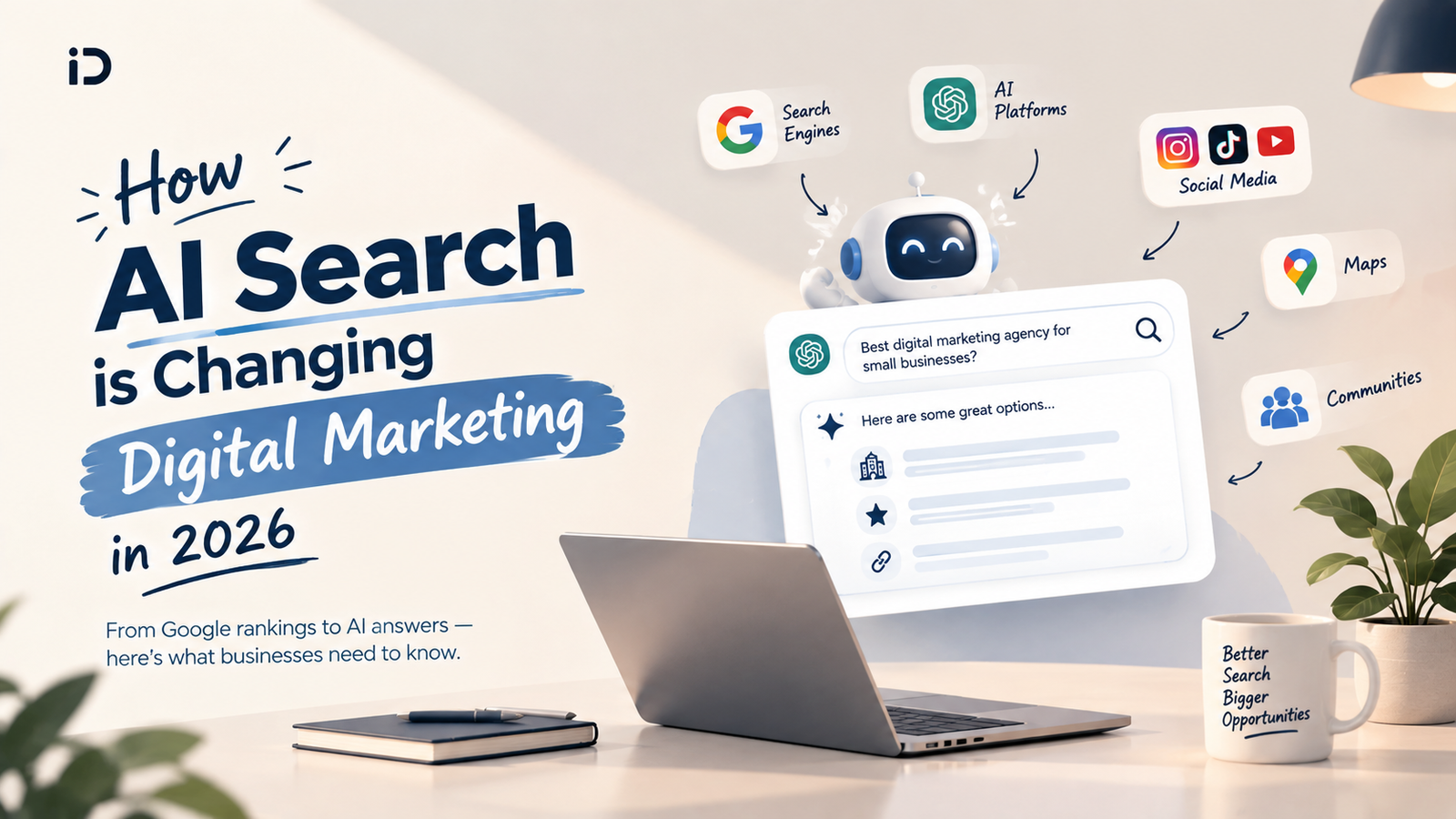
HOW AI SEARCH IS CHANGING DIGITAL MARKETING IN 2026
Search is changing.
Earlier, people would type a few keywords into Google, scan the results, click a website, and find their answer.
Today, people are increasingly asking longer and more specific questions to AI tools such as ChatGPT, Gemini, Perplexity, and Google’s AI-powered search features.
This shift is creating a new focus for marketers: Answer Engine Optimization (AEO).
What Is Answer Engine Optimization (AEO)?
AEO is the process of creating and structuring your online presence so that AI-powered search systems can understand your business and potentially include, cite, or recommend it when answering relevant questions.
Traditional SEO focuses heavily on ranking webpages in search results.
AEO focuses on being understood and referenced in AI-generated answers.
Importantly, AEO does not replace SEO. Search engines and traditional SEO remain important, but the search journey is becoming more fragmented across search engines, AI assistants, social platforms, maps, and other discovery channels.
Why AI Search Matters for Businesses
Imagine someone asking: “Which digital marketing agency can help a small business grow on social media?”
Instead of receiving ten blue links, the user may receive a direct AI-generated response with a smaller set of recommendations.
That means your brand may need more than a good Google ranking.
Your website, reviews, content, social presence, expertise, and brand mentions can all contribute to how clearly an AI system understands your business.
Recent research from HubSpot found that CRM buyers using AI search were 36% more likely to purchase than those who didn’t, although this is specific to HubSpot’s dataset and should not be treated as a universal conversion rate.
How Businesses Can Prepare for AI Search
1. Create content that answers real questions
Don’t create content only around keywords.
Create content around the questions your customers actually ask.
For example:
- ~”What does social media management include?”
- ~“How much does digital marketing cost for a small business?”
- ~“How can a restaurant get more customers through Instagram?”
Clear, useful answers give search and AI systems more context about your expertise.
2. Build topical authority
One random blog post isn’t enough to establish expertise.
Create multiple useful pieces of content around the same area.
For example, a digital marketing agency could cover:
- ~Social media strategy
- ~Instagram marketing
- ~Content creation
- ~Lead generation
- ~Local SEO
- ~Google Business Profile
- ~Paid advertising
- ~Influencer marketing
This creates a stronger content ecosystem around your expertise.
3. Make your business information consistent
Your website, Google Business Profile, social profiles, directories, and other online listings should communicate consistent information.
Keep your:
- ~Business name
- ~Services
- ~Location
- ~Contact information
- ~Website
- ~Descriptions
clear and up to date.
4. Don’t ignore reviews and third-party mentions
AI systems don’t only learn from your website.
Your wider online presence matters too.
Reviews, publications, industry websites, directories, social platforms, and other credible sources can provide additional context about your brand.
This makes reputation management increasingly important alongside traditional SEO.
5. Write for humans first
One of the biggest mistakes businesses can make is filling their website with generic AI-generated articles just to produce more content.
Google has continued to emphasize quality and spam policies, including for generative AI features.
AI can help with research, ideation, and content workflows.
But your content still needs original insight, real experience, useful information, and a clear point of view.
FAQs
Q-1 What is AEO in digital marketing?
AEO stands for Answer Engine Optimization. It focuses on making content and brand information easier for AI-powered systems to understand and potentially reference in answers.
Q-2 Is AEO replacing SEO?
No. AEO and SEO work alongside each other. Traditional search remains important while AI-powered discovery adds another visibility channel.
Q-3 How can a small business prepare for AI search?
Start with clear website information, helpful customer-focused content, consistent business listings, genuine reviews, and content that directly answers common customer questions.
Q-4 Does AI-generated content help with AEO?
AI can assist with content creation, but simply producing large amounts of generic AI content isn’t a strategy. Useful, accurate, original, people-first content remains important.
Q-5 What is the difference between SEO and AEO?
SEO primarily focuses on visibility in search results, while AEO focuses on making information useful and understandable for answer-based and AI-powered search experiences.
Final Thoughts
AI search is changing how people discover information, brands, and businesses online. For businesses, this means digital marketing can no longer focus only on Google rankings.
The future is about being visible, useful, trustworthy, and easy to understand across search engines, AI platforms, social media, maps, and other digital channels.
SEO is evolving, and AEO is becoming another important part of the strategy.
The businesses that focus on answering real customer questions, creating valuable content, and building genuine online authority will be better prepared for where search is heading.
The goal isn’t to chase AI. It’s to make your brand easier to discover, understand, and trust.