
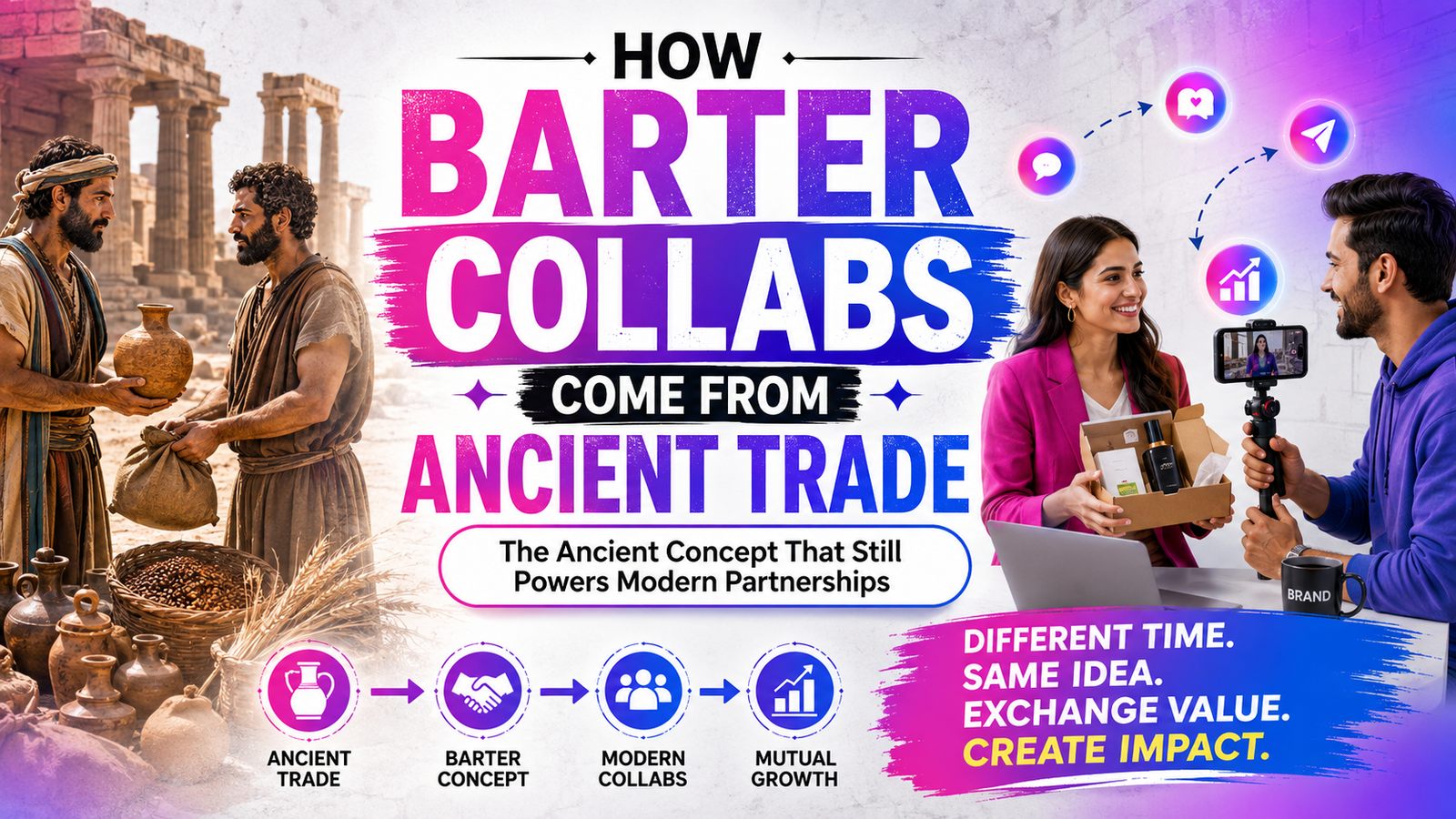
What Is the Barter System?
The barter system is a method of exchanging goods or services directly for other goods or services without using money as the primary medium of exchange.
For example: A farmer provides wheat to a carpenter, and the carpenter provides tools or furniture in return.
There is no cash involved. Both parties simply exchange something they have for something they value.
According to educational resources from the Federal Reserve, barter existed before universally accepted forms of money and involved exchanging goods and services directly. (Federal Reserve Education)
However, barter was not always as simple as it sounds.
Both parties needed to want what the other person was offering. Economists refer to this challenge as a “double coincidence of wants.” (Federal Reserve Bank of Minneapolis)
That limitation eventually contributed to the development and wider use of money and other exchange mechanisms.
How Barter Collaborations Came From Ancient Times
To understand modern barter collaboration, we first need to look at the original purpose of barter.
Ancient communities produced different things depending on their skills, environment, and resources.
One person might have food. Another might have tools. someone else might provide craftsmanship or labour.
Instead of keeping everything for themselves, people could exchange what they had for what they needed.
Ancient trade networks became increasingly sophisticated. For example, trade in Mesopotamia began locally during the Ubaid period and expanded into long-distance trade by the Uruk period. (World History Encyclopedia)
Over time, societies developed other forms of exchange and commodity money. Historical educational material from the Federal Reserve notes that different goods, including shells, tea, and other commodities: served as forms of value in different cultures. (Federal Reserve Education)
So, barter should not be viewed as a single system that existed everywhere in exactly the same way. Different societies used different methods of exchanging value.
Why Did Ancient People Use Barter?
1. Money Was Not Always Available
Before modern monetary systems, people could not simply pull out a wallet and pay for something. Direct exchange was one way to obtain goods or services.
2. People Had Different Resources
A farmer, craftsman, hunter, trader, or builder could each possess something another person needed. Barter allowed those differences to become useful.
3. Value Was Based on Practical Needs
A product didn’t necessarily need a fixed monetary price. Its value could depend on how useful it was to the person receiving it.
4. Trust Was Important
A successful exchange required both sides to believe that what they were receiving had sufficient value. That element of trust remains important in modern collaborations too.
From Ancient Barter to Modern Business
The interesting part is that the concept didn’t disappear when money became dominant.
Instead, it evolved.
Money made transactions much easier because people no longer needed to find someone who wanted exactly what they were offering. This is one reason money became an important medium of exchange. (Federal Reserve Education)
But businesses still sometimes exchange value directly.
That’s where the modern barter collaboration comes in.
Instead of: Product → Money → Service
the transaction can become: Product/Service → Value → Promotion/Service/Product
For example: Brand → Free Product → CreatorIn return: Creator → Content + Exposure → Brand
The exchange is different from traditional buying and selling, but the underlying principle is surprisingly familiar.
What Is a Barter Collaboration?
A barter collaboration is a partnership where two parties exchange products, services, skills, access, or promotional value instead of or sometimes alongside: direct monetary payment.
For example: Influencer + Restaurant
A restaurant provides a complimentary dining experience.
The creator provides agreed content such as:
- Instagram Reel
- Stories
- Photos
- Reviews
- User-generated content
Brand + Creator
A brand sends products to a creator.
The creator creates content featuring those products.
Business + Service Provider
A business provides its product or service to a professional.
The professional provides another valuable service in return.
The modern barter collaboration therefore works on a simple question:
“What can I offer, and what can you offer in return?”
What Is the Connection Between Ancient Barter and Barter Collaboration?
The connection can be understood through one simple principle:
Exchange value instead of simply exchanging money.
Ancient barter was based on exchanging things that people valued.
Modern barter collaborations work in a similar way.
The difference is that value has expanded.
In ancient trade, value could be:
- Food
- Tools
- Clothing
- Livestock
- Raw materials
- Labour
- Craftsmanship
In modern marketing, value can include:
- Products
- Services
- Content
- Audience access
- Reach
- Expertise
- Brand exposure
- Creative skills
- Distribution
So, a modern creator’s content and audience can become part of the exchange.
How Barter Collaboration Works in Digital Marketing
Modern digital marketing has made barter collaborations particularly interesting.
A brand doesn’t always need to pay a creator entirely in cash.
Instead, it may offer something that has meaningful value to the creator.
For example: Brand offers:
Product worth ₹5,000
Creator offers:
1 Reel + 3 Stories + product photography
Or:
Agency offers: Social media strategy
Business offers: Professional photography, venue access, or another agreed service.
The important factor is not simply the price of the product.
It is the perceived value for both sides.
Why Are Barter Collaborations Popular With Brands?
1. They Can Reduce Initial Marketing Costs
For startups and small businesses, cash budgets can be limited. A barter collaboration can allow a brand to access content or exposure without paying the entire collaboration fee upfront.
2. They Can Generate Authentic Content
Creators actually using a product can produce content that feels more natural than traditional advertising.
3. They Can Help New Brands Get Visibility
A small business may not yet have a large advertising budget. Collaborating with relevant creators can help introduce the brand to a new audience.
4. They Can Create Long-Term Partnerships
A successful barter collaboration doesn’t necessarily have to end after one post. If both sides receive genuine value, it can develop into a longer business relationship.
When Should a Brand Choose a Barter Collaboration?
Barter collaboration can be useful when:
- The brand has a valuable product or service.
- The creator genuinely wants the product.
- The creator’s audience matches the target customer.
- The expected content has meaningful marketing value.
- Both sides clearly agree on deliverables.
- The collaboration makes financial sense for both parties.
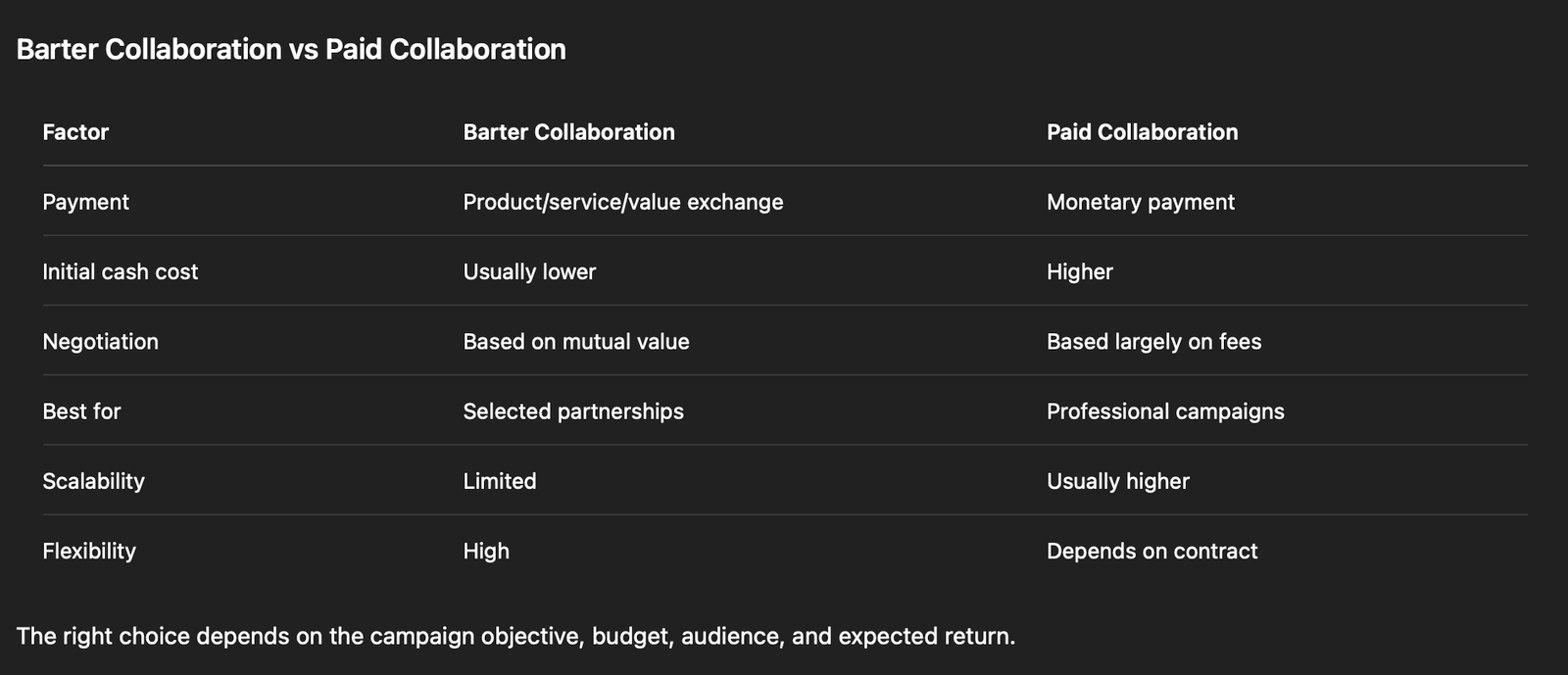
However, barter is not automatically better than paid marketing.
If a creator has a highly engaged and relevant audience, their professional time and distribution can have significant monetary value.
What Are the Disadvantages of Barter Collaboration?
Barter collaboration also has limitations.
Lack of Clear Valuation
It can be difficult to decide whether a product is fairly valued against the creator’s work.
Wrong Audience
A free product means very little if the creator’s audience isn’t relevant to the brand.
Unclear Expectations
Without a written agreement, both parties may expect different deliverables.
Content Quality Issues
A brand may expect professional content while the creator may interpret the deal differently.
Limited Scalability
Barter can work well for selected collaborations, but it may not replace a complete paid marketing strategy.
Final Thought:
Barter may be ancient, but the idea of exchanging value never gets old. From goods and services to products, content, and exposure
The method changed, but the concept stayed the same.