
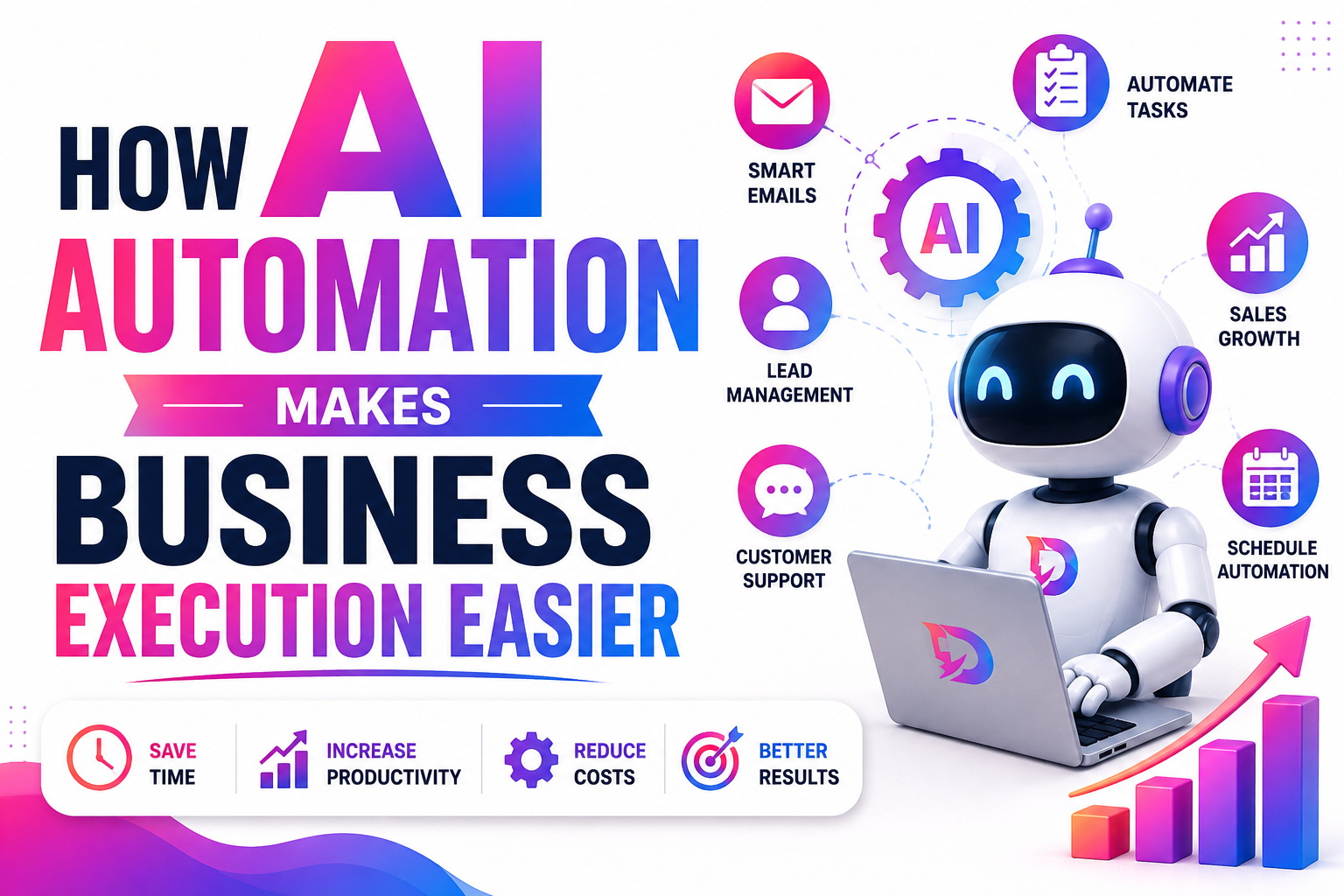
Running a business involves much more than selling a product or service. From answering customer queries and following up with leads to managing employees, creating content, sending emails, updating records, and preparing reports, business owners and teams handle hundreds of tasks every day.
The problem is that many of these tasks are repetitive.
This is where AI automation is changing the way businesses operate.
Instead of asking employees to manually complete every small task, businesses can use AI-powered systems to handle repetitive work automatically. This allows teams to spend more time on strategy, creativity, customer relationships, and revenue-generating activities.
But what exactly makes automation so useful?
Let’s understand how AI automation makes business execution easier, where it can be used, what its benefits are, and how businesses can implement it without making their operations unnecessarily complicated.
What Is AI Automation?
AI automation combines Artificial Intelligence (AI) with automated workflows to perform tasks with minimal human intervention.
Traditional automation follows predefined rules.
For example:
“When a customer submits a form, send them an email.”
AI automation can go a step further.
It can understand information, identify patterns, make recommendations, categorize requests, generate responses, and trigger appropriate actions based on the situation.
For example, an AI system could:
- Read a customer inquiry
- Understand what the customer needs
- Categorize the lead
- Add the information to a CRM
- Send a personalized response
- Notify the sales team
- Schedule a follow-up
- Update the customer record
This is one of the biggest reasons how AI automation makes business execution easier has become an important conversation for modern businesses.
Continue using AI Cursor?Keep it onTurn Off
Why Are Businesses Moving Towards AI Automation?
Businesses are under constant pressure to work faster while maintaining quality.
Customers expect quick responses. Employees need efficient systems. Marketing teams have to publish consistently. Sales teams need timely follow-ups.
Doing everything manually becomes difficult as the business grows.
AI Automation Helps Solve Three Major Problems
1. Too much repetitive work- Employees often spend hours performing tasks that don’t require complex decision-making.
2. Missed opportunities- A delayed response or forgotten follow-up can result in a lost customer.
3. Lack of operational consistency- When processes depend entirely on people remembering every step, mistakes become more likely.
AI automation can create repeatable workflows that help businesses execute everyday processes more consistently.
How AI Automation Makes Business Execution Easier
The biggest advantage is not simply that AI “does work.”
The real advantage is that it can connect different parts of a business into a smoother workflow.
1. AI Automation Reduces Repetitive Work
Imagine a sales executive receiving 50 new inquiries.
Without automation, someone may need to:
- Check every inquiry
- Enter customer details
- Send a welcome message
- Assign leads
- Set reminders
- Follow up manually
With an automated workflow, many of these steps can happen automatically.
The employee can then focus on qualified prospects instead of spending the entire day updating spreadsheets.
This demonstrates how AI automation makes business execution easier by removing unnecessary manual steps.
2. AI Automation Helps Businesses Respond Faster
Speed matters in business.
A potential customer who doesn’t receive a response may contact another company.
AI-powered chatbots, email systems, and messaging workflows can provide immediate responses to common questions.
For example:
Customer: “What are your service packages?”
AI: Provides the relevant information.
Customer: “I want to book a consultation.”
Automation: Collects the required information and triggers the appropriate booking workflow.
The customer doesn’t have to wait for someone to become available just to receive basic information.
3. AI Automation Makes Lead Management Easier
Lead management is one of the most practical applications of AI automation.
A business can create a workflow like:
Lead Generated → Lead Captured → Lead Qualified → CRM Updated → Sales Team Notified → Follow-Up Scheduled
Instead of manually coordinating every step, the system can manage the workflow automatically.
AI can also help categorize leads based on information such as:
- Industry
- Location
- Budget
- Requirements
- Previous interactions
- Buying intent
The sales team can then prioritize leads that require immediate attention.
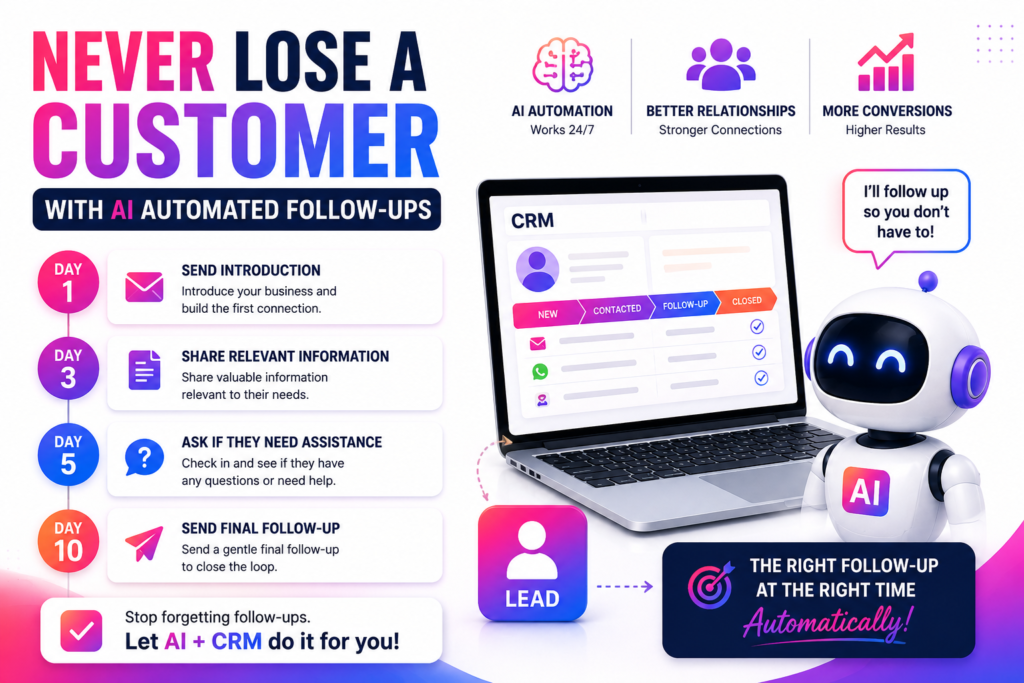
4. AI Automation Improves Follow-Ups
AI Automation in Marketing
Sales teams can benefit significantly from automation because many sales activities involve repetitive administration.
AI automation can assist with:
- Lead qualification
- CRM updates
- Meeting scheduling
- Follow-up reminders
- Sales reporting
- Customer segmentation
- Proposal workflows
For example, when someone fills out a lead form, the system can automatically add the information to the CRM and notify the relevant salesperson.
The salesperson can then spend more time speaking with the prospect.
AI Automation in Customer Support
Customer service is another area where AI automation can reduce workload.
AI can handle frequently asked questions such as:
- Business hours
- Service information
- Basic pricing information
- Order status
- Appointment information
- Frequently requested documents
More complicated issues can be transferred to a human representative.
This creates a human + AI support model instead of trying to completely replace human interaction.
AI Automation for Small Businesses
AI automation isn’t only for large corporations.
Small businesses can also automate simple processes without building complicated technology systems.
For example, a local business could automate:
Website Inquiry → WhatsApp Message → Lead Form → CRM Entry → Sales Notification → Follow-Up
A small team can therefore manage a larger volume of inquiries without increasing administrative work at the same rate.
This is particularly useful for businesses that are growing but don’t yet have large operational teams.
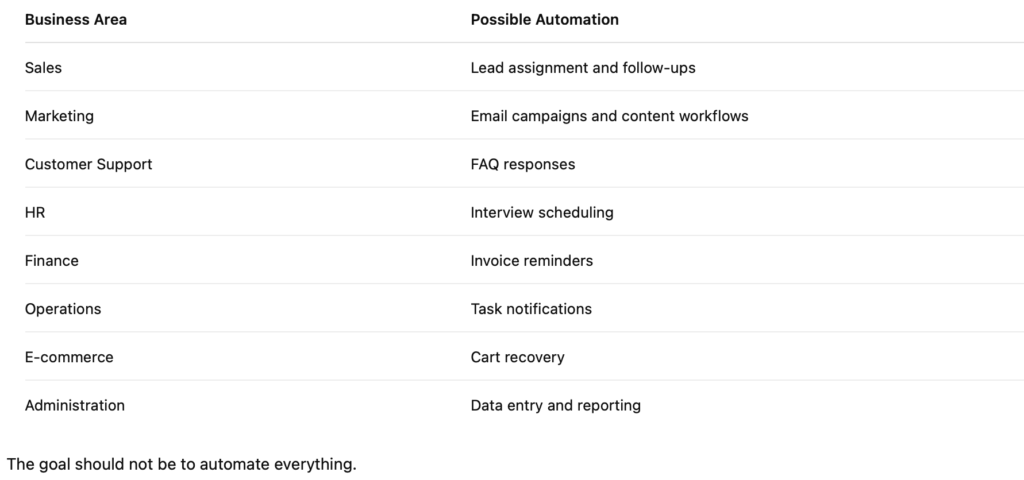
What Business Tasks Can Be Automated?
Not every business task should be automated.
The best candidates are usually tasks that are:
- Repetitive
- Rule-based
- Time-consuming
- High-volume
- Easy to measure
- Dependent on structured information
Examples include:
What Are the Benefits of AI Automation?
Increased Productivity
Employees spend less time on repetitive administrative work.
Faster Execution
Automated workflows can trigger actions immediately when predefined conditions are met.
Fewer Manual Errors
Reducing repetitive data entry can reduce certain types of human mistakes.
Better Customer Experience
Customers can receive faster and more consistent communication.
Improved Scalability
Businesses can handle increasing workloads without every process requiring proportional manual effort.
Better Visibility
Connected systems can make it easier to track leads, tasks, customers, and workflow performance.
Does AI Automation Replace Employees?
This is one of the most common concerns about AI.
In most businesses, the more practical approach is not AI versus employees.
It is AI + employees.
AI is particularly useful for repetitive and information-heavy tasks, while people remain important for:
- Strategy
- Creativity
- Negotiation
- Leadership
- Relationship building
- Complex decision-making
- Emotional understanding
- Business judgment
A salesperson should ideally spend more time talking to customers and less time copying customer information between systems.
That’s where automation becomes valuable.
What Are the Risks of AI Automation?
AI automation has significant benefits, but it should not be implemented without planning.
Data Privacy
Businesses must carefully consider what customer and business information is shared with AI tools.
Incorrect AI Responses
AI can sometimes produce inaccurate or inappropriate information. Important customer-facing workflows should have appropriate checks.
Over-Automation
Automating every interaction can make a brand feel robotic.
Customers should still have access to human support when necessary.
Poor Workflow Design
Automation cannot fix a broken business process.
If the original process is confusing, automating it may simply make the confusion happen faster.
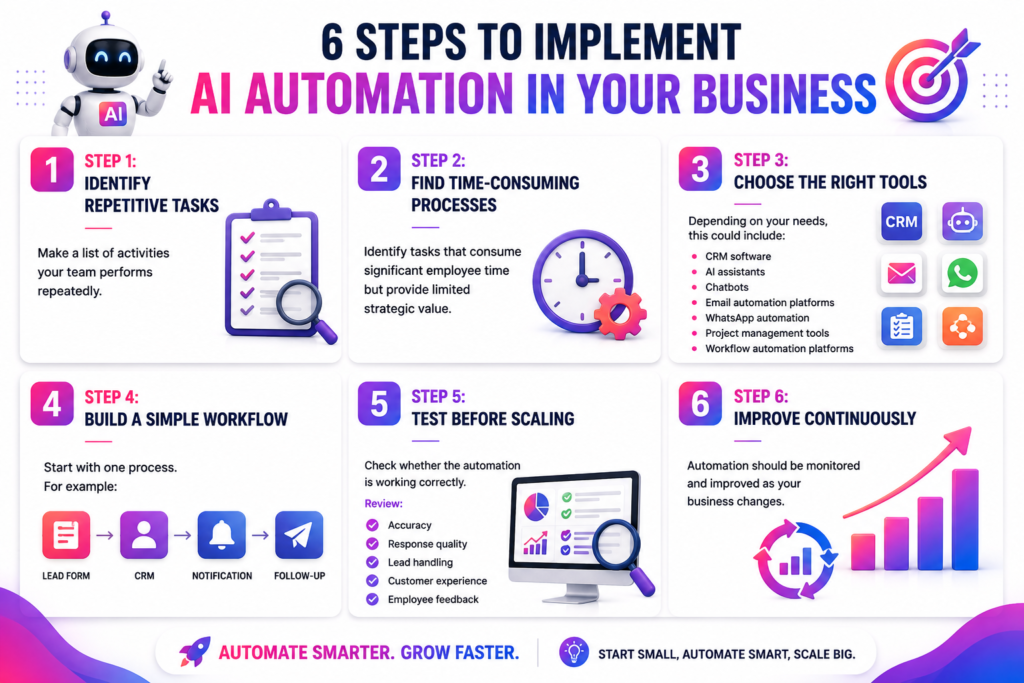
How to Start AI Automation in Your Business
Final Thoughts
AI automation is not simply about making machines do more work.
It is about helping businesses remove unnecessary steps, respond faster, organize information better, and give employees more time to focus on work that genuinely requires human thinking.
The businesses that benefit most from AI automation will not necessarily be the ones using the most AI tools.
They will be the ones using the right automation for the right problems.
If your business is still spending hours on repetitive tasks, missed follow-ups, manual data entry, or disconnected workflows, it may be time to explore where AI automation can make your operations simpler.
At Divyash Digital, our focus is to make technology practical, understandable, and aligned with your business goals.
How AI automation helps business, AI automation for business, Business process automation, AI workflow automation, Benefits of AI automation, AI automation tools