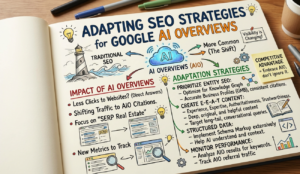
Search Has Changed-Has Your Strategy?
For years, digital marketers focused on one goal: ranking higher on Google. But today’s users don’t just search - they ask questions.
Instead of typing keywords into search engines, people now ask:
- “What’s the best CRM for small businesses?”
- “How can I improve my website traffic?”
- “Which digital marketing agency is best for startups?”
These questions are increasingly answered by:
- Google AI Overviews
- ChatGPT
- Gemini
- Perplexity
- Voice assistants
- Bing Copilot
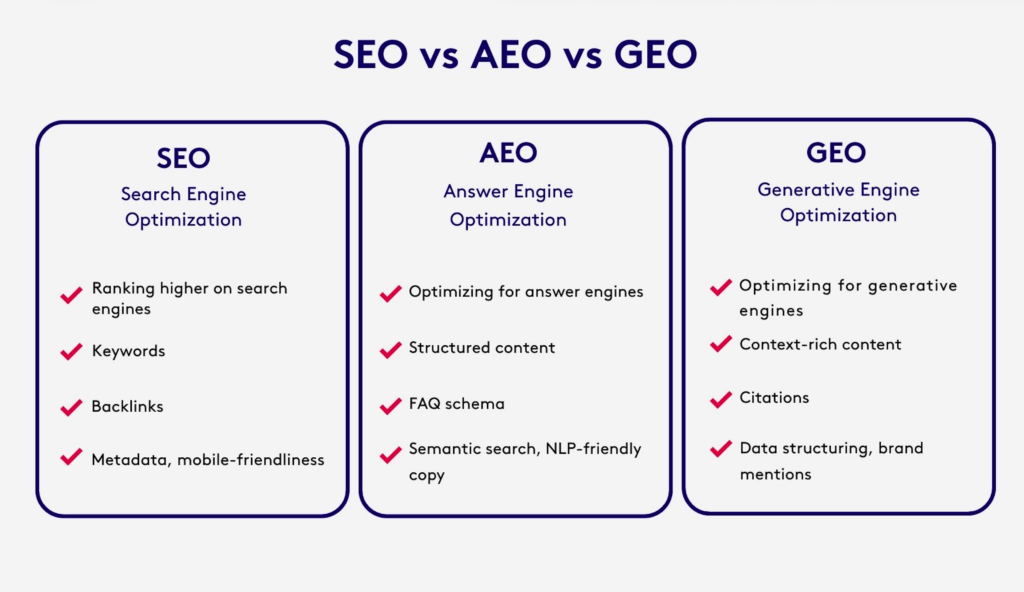
As a result, businesses must optimize not only for search engines but also for answer engines and generative AI platforms.
This shift has introduced two new disciplines alongside traditional SEO:
- AEO (Answer Engine Optimization)
- GEO (Generative Engine Optimization)
Understanding how these strategies work together is essential for maintaining online visibility in 2026 and beyond.
What is SEO?
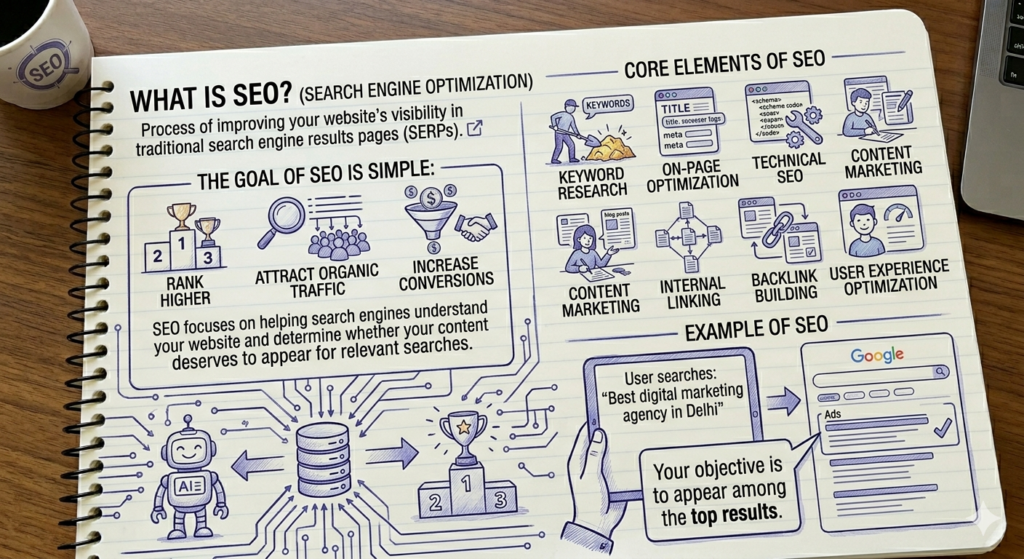
Search Engine Optimization (SEO) is the process of improving your website’s visibility in traditional search engine results pages (SERPs).
The goal of SEO is simple:
Rank higher, attract organic traffic, and increase conversions.
SEO focuses on helping search engines understand your website and determine whether your content deserves to appear for relevant searches.
Core Elements of SEO
- Keyword research
- On-page optimization
- Technical SEO
- Content marketing
- Internal linking
- Backlink building
- User experience optimization
Example of SEO
- A user searches:
- “Best digital marketing agency in Delhi”
- Google displays a list of websites.
- Your objective is to appear among the top results.
What is AEO?
Answer Engine Optimisation (AEO)
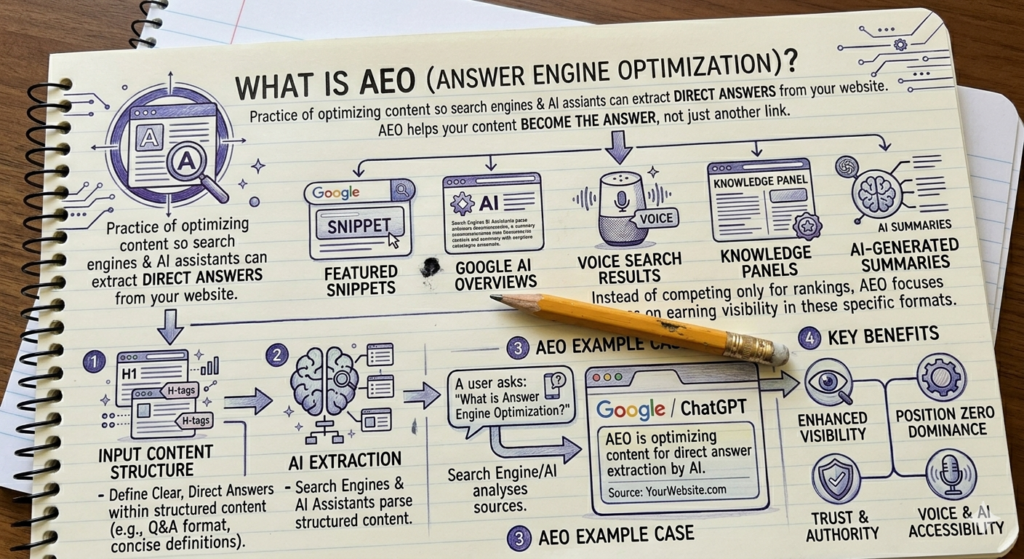
It is the practice of optimizing content so that search engines and AI assistants can extract direct answers from your website.
It focuses on earning visibility in:
- Featured snippets
- Google AI Overviews
- Voice search results
- Knowledge panels
- AI-generated summaries
Example of AEO
A user asks:
“What is Answer Engine Optimization?”
Google or ChatGPT may display a short answer directly on the screen.
If your content is structured correctly, your website could be the source of that answer.
What is GEO?
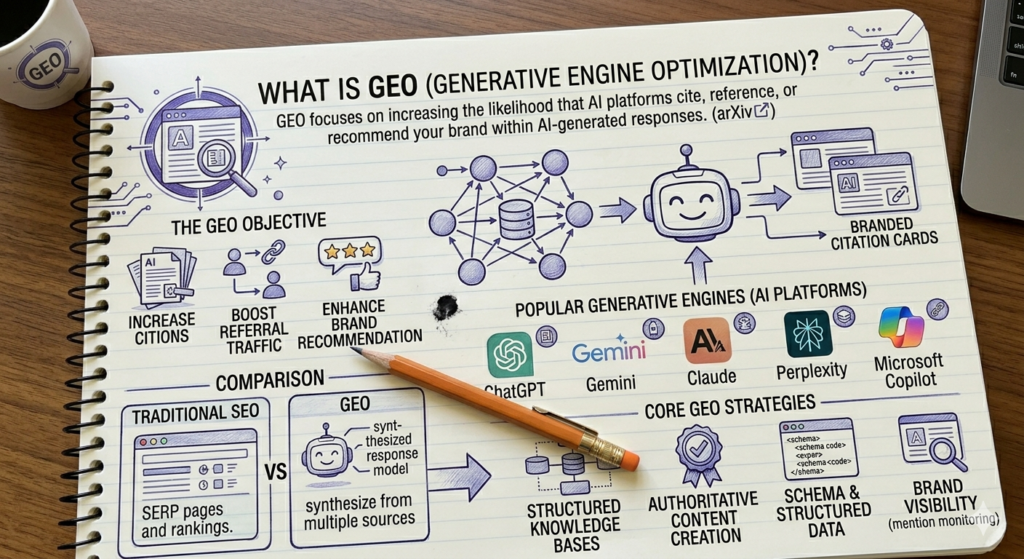
Generative Engine Optimization (GEO)
focuses on increasing the likelihood that AI platforms cite, reference, or recommend your brand within AI-generated responses. (arXiv)
Unlike traditional search engines that rank pages, generative engines synthesize information from multiple sources before presenting an answer.
Instead of displaying a list of links for users to click, these platforms generate conversational responses by gathering, analyzing, and combining information from multiple sources.
For example, when a user asks:
“Which digital marketing strategies work best for small businesses in 2026?”
An AI platform may create a single answer using insights from industry reports, expert blogs, case studies, research papers, forums, and trusted websites.
The goal of GEO is to increase the chances that your content becomes one of those trusted sources.
Popular generative engines include:
- ChatGPT
- Gemini
- Claude
- Perplexity
- Microsoft Copilot
The goal of GEO is not simply to rank—it is to become a trusted source for AI systems.
Example of GEO
A user asks:
“Which digital marketing agencies help startups grow organically?”
Instead of showing links, ChatGPT generates a response using information gathered from multiple trusted sources.
GEO increases your chances of being mentioned in that answer.
Why Traditional SEO Alone Is No Longer Enough?
Search behavior is evolving rapidly.
Users increasingly expect immediate, conversational answers.
Google now provides AI-generated summaries for many informational queries, reducing clicks to traditional search results. (Networkers Home)
This trend has created:
- More zero-click searches
- Greater competition for visibility
- Increased reliance on AI assistants
- Higher importance of brand authority
- SEO remains essential—but it is no longer sufficient on its own. (Alice)
Conclusion
The way people discover information online is changing faster than ever.
Traditional search engines are no longer the only gateway to your audience. Today, users expect instant, conversational, and highly relevant answers—whether they come from Google Search, AI Overviews, voice assistants, or generative AI platforms.
This shift has expanded the search landscape beyond traditional SEO.
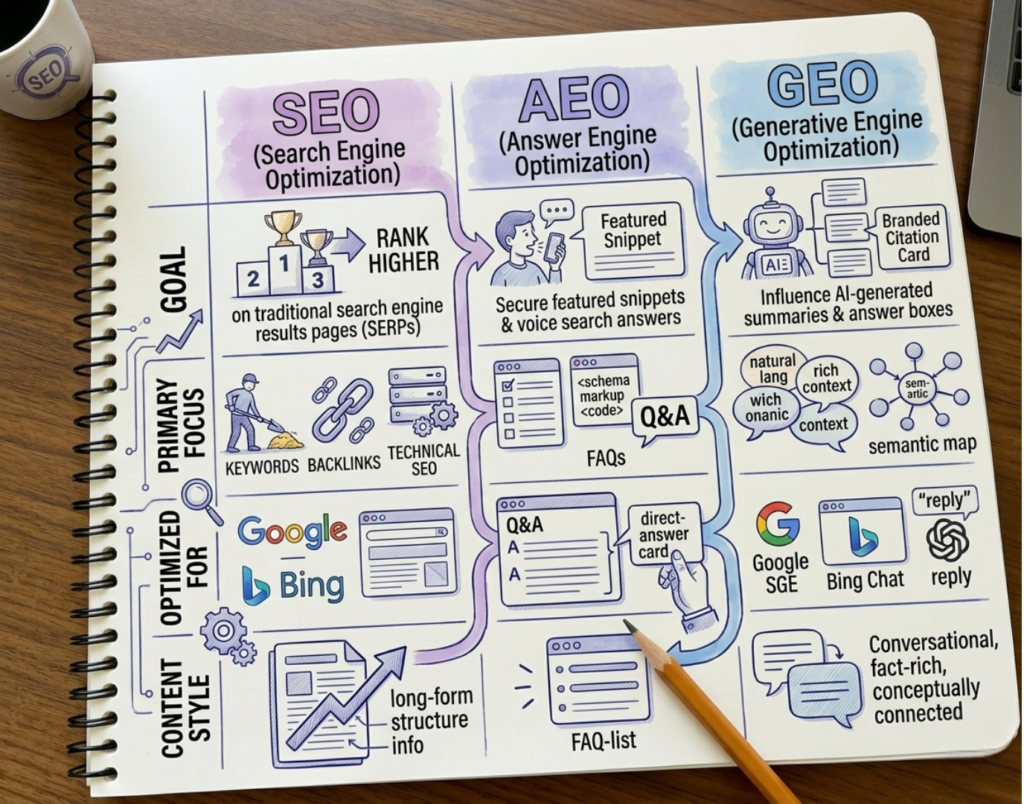
- SEO helps your website rank in search results.
- AEO helps your content become the answer users see instantly.
- GEO helps AI platforms recognize and recommend your brand as a trusted source.
The businesses that succeed in the AI era ?
Won’t focus on just one strategy. Instead, they will build authority, create high-quality content, and optimize their digital presence across every search experience.
While SEO remains the foundation of online visibility, integrating AEO and GEO into your strategy will help you stay competitive as search continues to evolve.
The future of search isn’t about choosing between SEO, AEO, and GEO—it’s about understanding when and how to use each one effectively.
What's Next?
In this blog, we’ve explored the key differences between SEO, AEO, and GEO.
In our next article, we’ll dive deeper into how SEO, AEO, and GEO work together to create a future-ready search strategy, including practical frameworks, optimization techniques, and actionable steps your business can implement today.
Stay tuned to the Divyash Digital blog for more insights on AI search optimization and the future of digital marketing.